
Pitch vs formants: how to hear the difference
A short explanation of pitch vs formants, why they change how your voice sounds, and how to hear the difference using Strivocal's audio demo.
Written by: Charlie Murphy
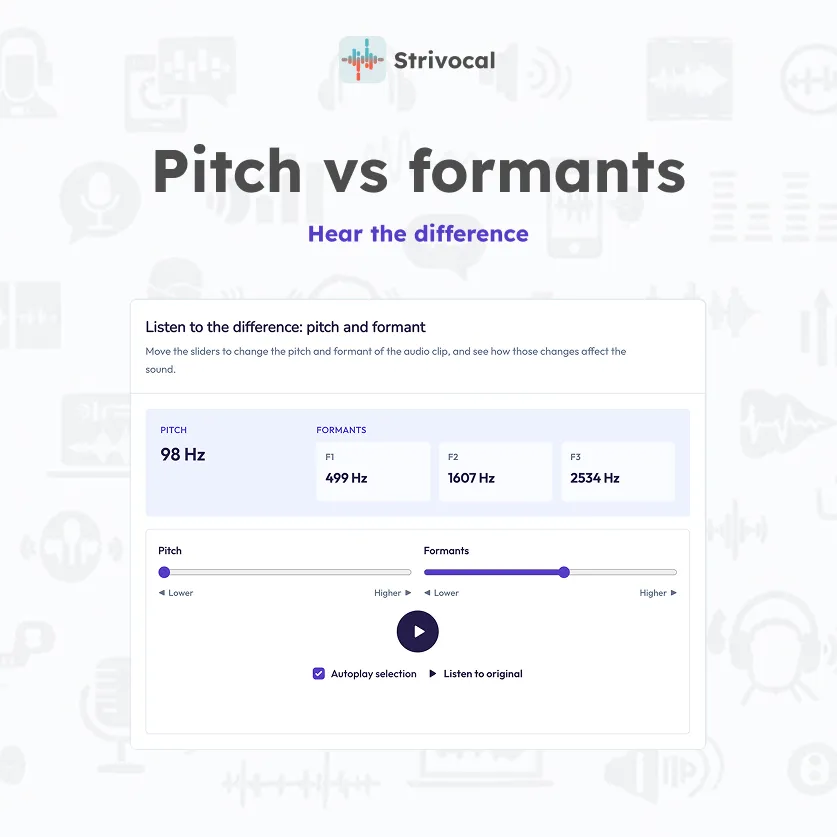
Pitch and formants both affect how your voice sounds, but they are not the same thing. Pitch is easiest for most people to notice first: is the voice higher or lower? Whereas formants shape resonance, brightness, darkness, and perceived size of the voice. That difference can be hard to understand from definitions alone, so try the interactive audio demo below to hear the difference.
Listen to the difference
Start by playing the original clip, then change one slider at a time. Move only pitch and listen for the shift in how high or low the voice sounds. Return to the original, move only formants, and listen for changes in brightness, darkness, or apparent vocal size. After that, try changing both sliders and notice how the two effects interact.
Listen to the difference: pitch and formant
Move the sliders to change the pitch and formant of the audio clip, and see how those changes affect the sound.
Pitch
--
--
Formants
- F1
- --
- --
- F2
- --
- --
- F3
- --
- --
Audio clip from Mozilla Common Voice. Praat was used to generate the pitch and formant variants, which may not be perfectly accurate so you may notice some artifacts in the audio.
Pitch changes how high or low the voice sounds
Pitch describes how high or low a voice sounds. In voice analysis, this is usually measured as fundamental frequency, or F0, in hertz. When pitch goes up, the vocal folds are vibrating more times per second. When pitch goes down, they are vibrating fewer times per second. In the audio demo, moving the pitch slider to a higher value makes the voice sound higher, like a falsetto or a squeaky voice.
Formants change the shape of the sound
Formants are frequency regions shaped by the vocal tract. Your throat, mouth, tongue, jaw, and lips all influence them. If pitch is related to the source of the sound, formants are related to how that sound is filtered after it is produced. This is why two people can speak at a similar pitch but still sound very different.
In the audio demo, moving the formant slider changes the apparent shape or size of the sound without simply making the voice “higher pitched” or “lower pitched.” Higher formants can make the voice sound brighter, smaller, or more forward. Lower formants can make it sound darker, larger, or more hollow. Those are listening impressions, not guarantees. The exact effect depends on the speaker, the words being spoken, and the rest of the voice.
Why pitch and formants can be confusing
People often use everyday language like “high voice,” “deep voice,” “bright voice,” or “dark voice.” Those descriptions can mix pitch and resonance together. For example:
- A voice can have a relatively high pitch but still sound dark or large.
- A voice can have a lower pitch but still sound bright or light.
- Two voices can share a similar average pitch but differ because their formants and resonance are different.
This is one reason pitch alone does not explain how a voice is perceived. Pitch matters, but formants, vocal weight, volume, articulation, intonation, and speaking style all contribute to the overall sound.
How this helps voice training
If you are working on voice training, understanding pitch vs formants can make practice less vague. Instead of asking only, “Is my voice high enough?” you can ask more specific questions:
- Is my pitch moving in the range I want?
- Does my resonance sound brighter, darker, smaller, or larger?
- Do my vowels change when I adjust my mouth or tongue position?
- Does this sound feel comfortable and repeatable?
Strivocal gives feedback on pitch, formants, volume, and perceived gender so you can compare what you hear with measurable patterns over time. That feedback is most helpful when it supports your own listening, comfort, and practice goals.
For a fuller set of definitions, examples, and related terms, read the full Voice Training Glossary: Pitch, Formants, Resonance.
Want to try out Strivocal?
Strivocal is available on the web, iOS, and Android. You can try it for free at strivocal.com.